The Artist
Nestor Ndzi Talla

Douala, Cameroon
Biography
Nestor Ndzi Talla is a Cameroonian painter whose practice navigates the fertile terrain between memory and imagination, landscape and line, materiality and spirit. Rooted in an African sensibility yet reaching toward universal questions, his work explores the unseen forces that shape human experience—ancestral memory, identity, belonging, and humanity's place within the vastness of the universe. Born in Bamenda and based in Douala, Talla developed an early sensitivity to the visual rhythms of his environment: the geometry of traditional forms, the symbolic language of indigenous art, and the shifting atmospheres of the landscapes that surrounded him. These influences continue to inform a practice that is deeply personal yet universally resonant.
Working primarily in acrylic and mixed media on canvas, Talla has established a distinctive visual language that dissolves the boundaries between abstraction and representation. His paintings emerge through layered gestures, fluid structures, textures, and luminous fields of color, constructing spaces that feel at once intimate and expansive. Rather than depicting landscapes as physical places, he approaches them as emotional and metaphysical territories—sites where memory, history, energy, and perception converge.
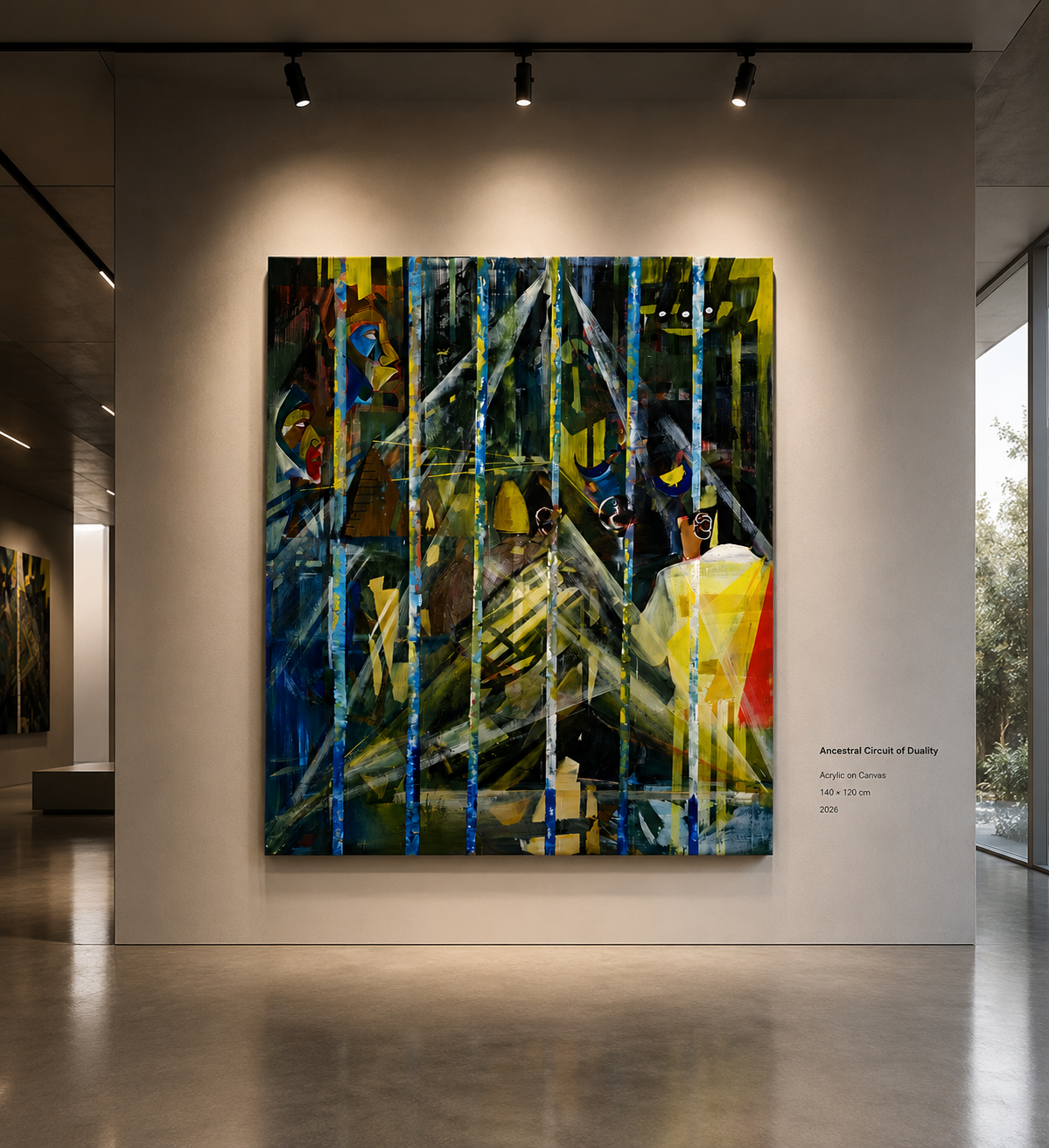
The verticality of line occupies a central role in his work. Recurring linear movements create pathways through the picture plane, acting as both structure and symbol. Rising, intersecting, and dissolving across richly worked surfaces, these lines evoke growth, connection, transcendence, and the invisible forces that bind the earthly to the cosmic. Through them, Talla creates compositions that suggest movement beyond the visible, inviting contemplation of deeper realities that exist beneath ordinary perception. His paintings are less concerned with representation than with presence. They seek to evoke what lies beyond the visible world: traces of lived experience, collective memory, spiritual resonance, and the silent dialogue between humanity and the universe.
Through this exploration, he creates works that are both meditative and emotionally charged, offering spaces for reflection in an increasingly fragmented world.
From his studio in Douala, Talla continues to develop a body of work that contributes to the evolving discourse of contemporary African art while remaining grounded in the cultural depth of his heritage and engaged with questions that transcend geography, time, and place.
Artist Statement
I paint to give form to what resists language.
My work begins not with an image, but with a sensation—a rhythm remembered by the body, a fragment of landscape, an ancestral echo, or a presence that refuses to reveal itself fully. Painting becomes a process of listening, of following these subtle traces until they find their own visual expression. What emerges on the canvas is not an illustration of experience, but its residue: a field where memory, intuition, and perception converge.
I am drawn to thresholds—those liminal spaces between abstraction and representation, memory and imagination, the visible and the invisible. Each painting becomes a site of encounter where marks, gestures, textures, and lines accumulate like fragments of lived experience. Rather than depicting a place, I seek to evoke a state of being. The landscapes that appear within my work are not geographical territories but psychic and spiritual ones, shaped as much by remembrance and feeling as by physical reality.
Born in Cameroon, I carry within my practice the visual and spiritual inheritances of the environments that formed me. The density of the forest, the expansiveness of the coastline, the rhythms of urban and rural life, and the enduring presence of ancestral knowledge all inform my visual vocabulary. These influences are neither quoted nor illustrated directly; instead, they are transformed into movement, structure, atmosphere, and form. Landscape becomes language—a way of thinking through questions of identity, belonging, continuity, and transformation.
Vertical perception lies at the heart of my practice. I think of painting as an ascent through layers of experience—through memory, matter, darkness, and illumination. Working with earth-bound pigments, deep blacks, gestural lines, and luminous passages, I seek to create spaces where perception extends beyond the purely visual. Darkness is not absence in my work; it is a generative field, a place where memory accumulates and meaning begins to emerge. Light appears not as a destination, but as an encounter—a fleeting revelation within a larger mystery. Between pigment, darkness, and illumination, the painting becomes a threshold through which the visible and invisible enter into conversation.
My process is one of layering, erasure, and discovery. Acrylic and mixed media allow me to build surfaces that carry both tension and depth, where every mark retains the history of those that came before it. I welcome uncertainty as a necessary part of the work. The painting evolves through a dialogue between intention and surrender, allowing unexpected relationships, forms, and energies to surface over time.
I consider my practice part of an ongoing conversation within contemporary African art—not as a category of geography, but as a living continuum of thought, material experimentation, and cultural imagination. My work exists within that continuum while remaining deeply personal. It does not seek to provide answers or fixed narratives. Instead, it offers spaces of contemplation, inviting viewers to slow down, to dwell within ambiguity, and to encounter what lies beyond the immediate surface of things.
Ultimately, my paintings are propositions rather than conclusions: questions rendered in pigment, line, darkness, and light. They are attempts to trace the invisible currents that move through memory, landscape, and spirit, and to create moments where the seen and the unseen briefly meet.
Inspiration
The Man Who Sees in Fragments of Obscurity
Born where red dust rose behind every step and the nights carried a kind of sacred obscurity. As a child, I often walked through the forest after sunset, guided only by the trembling glow of moonlight filtering through the leaves. In that darkness, the world broke into fragments—shapes, whispers, colours that appeared only to those who dared to look beyond the obvious. Those nights trained my eyes to see differently.
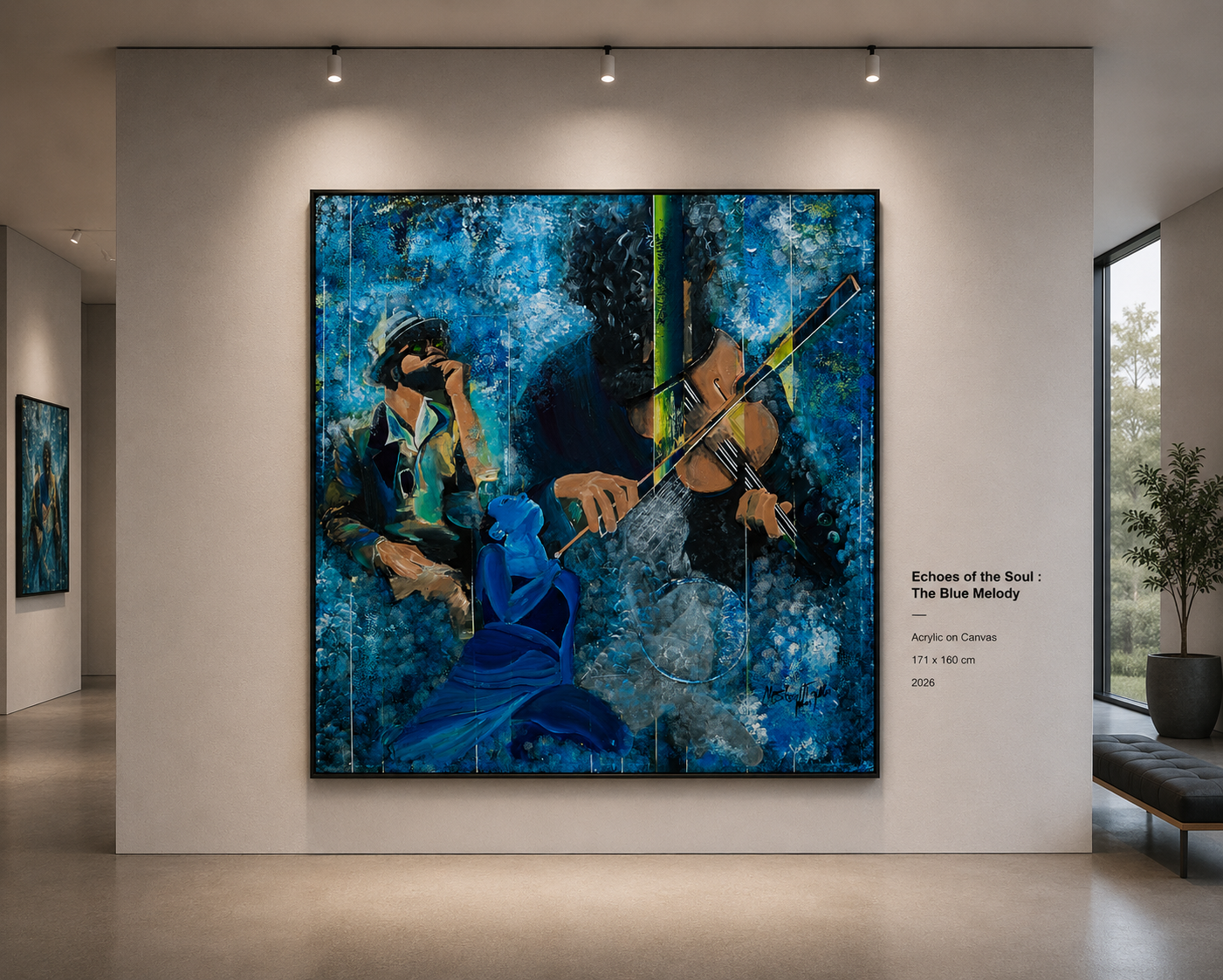
Even today, the modern world feels like a refinement of those childhood visions. When a man plays the saxophone, I do not see his whole body. I see only the parts that matter: the fingers sculpting the melody, the head holding the rhythm, the colours rising from the music like spirits lifting from the forest floor. Everything else dissolves into obscurity. What remains is essence.
My paintings come from that way of seeing—where life is reduced to its most meaningful fragments, where rhythm becomes colour, and where the invisible world of my childhood still breathes beneath the surface of modern scenes.
Collectors often tell me that my work feels like a memory they never lived, yet somehow recognize. Perhaps it is because every canvas carries a piece of those Bamenda nights: the dust, the silence, the spirits, the rhythm, the courage of walking alone and discovering that the world is full of hidden stories.
I paint because obscurity is not emptiness. It is a doorway. And I have spent my life learning how to walk through it.
The Studio
Timeline
Awards
Prix ...
... · 2022
Grand Prix ...
... Cameroon · 2020
...
... · 2018
Selected Exhibitions
International Group Exhibition
Details Coming Soon · 2027
Linear Echoes, Hidden Figures & Chromatic Illusions
In Preparation · 2026
Private Studio Viewing
Invitation Only · 2026
Hidden Figures & Mirrors
Digital Gallery · 2026
Cubist Reverberations
Studio Collection · 2026
Fragments of Identity
Studio Collection · 2024-2026
Illusion Studies
Digital Gallery · 2026
Collections
Burden of innocence, Cameroon
Abstract Collection, Cameroon
Sea Collection, Cameroon
The Blues Melody Collection, Cameroon
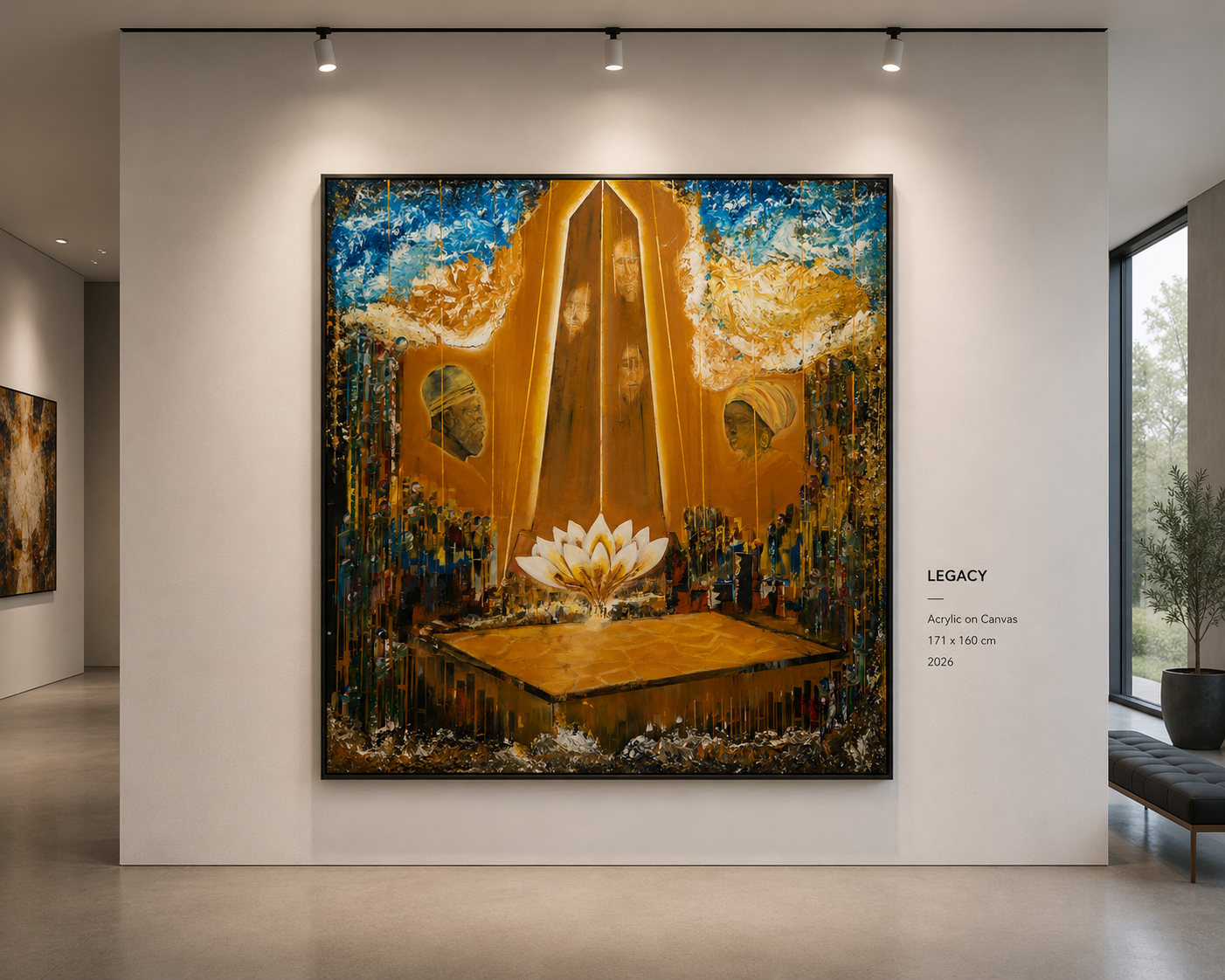
LEGACY Collection, Douala, Cameroon
Private Collection, Cameroon